This week I read further into the book Good to Great by Jim Collins.
In this chapter, Collins describes two cycles that demonstrate the way that business decisions tend to accumulate incrementally in either an advantageous or a disadvantageous manner. In essence, he is saying that failure cannot happen suddenly/instantly, rather it occurs over time, and vice versa.
He shows us that the transition from a good business to a great business is accomplished by following the flywheel effect:
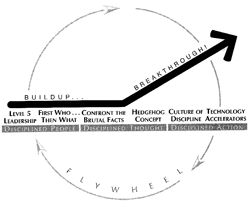
As a business gets steadily better, Collins comments, the ability of the company to reach greatness increases, because their momentum increases.
This is similar to our class, where if we work hard and we are getting closer to finishing, the harder we work, and therefore the more likely we are to succeed. For example, on the water bottle project (which I will explain in more detail on the Work Summary post), we pushed hard, and got a little bit far, but when we actually started pushing the selling, we accomplished our goal.
The last chapter of the book, Collins talked about long term success. He linked it with his other book, and said that the company has to have a set of core values to succeed in the long run. Without core values, the company will achieve success/greatness but will most likely fall apart after a short amount of time. Similarly to our class, if we don't keep up our goals and our core values, our business can fall short because we lack the vision when we don't keep core values.
Thanks for reading!
C4E Associate:
Noah Mark

I'm not sure I follow what you're saying in relation to the water bottle project. I'd like to hear more about this.
ReplyDelete