1/12/15 - 1/16/15: 7:03 PM
This week I focused my work effort mostly on the water bottle project. As this was the last week my group had to sell water bottles, we worked dilligently.
On Monday, our group met together and decided how we would finish selling our water bottles. I helped to decide on selling them on Thursday, during first and second lunch. Nitzan, Alex, and I sold water bottles during that time, and we made approximately $140 in sales. With a previous $40 in sales, we made a profit.
On the other days, I helped my group by working on the Presentation for the bankers and other town people about the Storefront Project. I worked on the slides about the financials, and I put together some of the graphics for other slides as well.
On Thursday, I also ran through a practice presentation in front of Mr. Fischer (unfortunately Ms. Stevens was unable to attend), and it went decently. We received comments on how to improve, and we started to take those comments into consideration.
C4E Associate:
Noah Mark
Sunday, January 18, 2015

1/1215 - 1/16/15: Reading Summary
1/1215 - 1/16/15: 6:44 PM
This week I read further into the book Good to Great by Jim Collins.
In this chapter, Collins describes two cycles that demonstrate the way that business decisions tend to accumulate incrementally in either an advantageous or a disadvantageous manner. In essence, he is saying that failure cannot happen suddenly/instantly, rather it occurs over time, and vice versa.
He shows us that the transition from a good business to a great business is accomplished by following the flywheel effect:
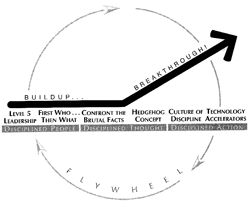
As a business gets steadily better, Collins comments, the ability of the company to reach greatness increases, because their momentum increases.
This is similar to our class, where if we work hard and we are getting closer to finishing, the harder we work, and therefore the more likely we are to succeed. For example, on the water bottle project (which I will explain in more detail on the Work Summary post), we pushed hard, and got a little bit far, but when we actually started pushing the selling, we accomplished our goal.
The last chapter of the book, Collins talked about long term success. He linked it with his other book, and said that the company has to have a set of core values to succeed in the long run. Without core values, the company will achieve success/greatness but will most likely fall apart after a short amount of time. Similarly to our class, if we don't keep up our goals and our core values, our business can fall short because we lack the vision when we don't keep core values.
Thanks for reading!
C4E Associate:
Noah Mark
This week I read further into the book Good to Great by Jim Collins.
In this chapter, Collins describes two cycles that demonstrate the way that business decisions tend to accumulate incrementally in either an advantageous or a disadvantageous manner. In essence, he is saying that failure cannot happen suddenly/instantly, rather it occurs over time, and vice versa.
He shows us that the transition from a good business to a great business is accomplished by following the flywheel effect:
As a business gets steadily better, Collins comments, the ability of the company to reach greatness increases, because their momentum increases.
This is similar to our class, where if we work hard and we are getting closer to finishing, the harder we work, and therefore the more likely we are to succeed. For example, on the water bottle project (which I will explain in more detail on the Work Summary post), we pushed hard, and got a little bit far, but when we actually started pushing the selling, we accomplished our goal.
The last chapter of the book, Collins talked about long term success. He linked it with his other book, and said that the company has to have a set of core values to succeed in the long run. Without core values, the company will achieve success/greatness but will most likely fall apart after a short amount of time. Similarly to our class, if we don't keep up our goals and our core values, our business can fall short because we lack the vision when we don't keep core values.
Thanks for reading!
C4E Associate:
Noah Mark
Sunday, January 11, 2015
1/5/15 - 1/9/15: Reading Summary
1/5/15 - 1/9/15: 12:40 PM
This week I read further into the book Good to Great by Jim Collins.
The chapters that I read focused on the so-called Hedgehog Concept, which contains three circles that comprise of what you are passionate about, what you can be the best in the world at, and what drives your so-called "economic engine" (which is a fancy way of saying you get paid for what you are doing). The intersection of all three points becomes the Hedgehog Concept. What this translates to in real life is if you have only the economic circle, you will only create a successful company, but not a great one.
This is similar to our class. If we are not invested emotionally or psychologically, we will never be able to bring our company to greatness, and likewise will not be able to put our greatest effort into the project/company. In addition, we are not getting paid, but at this stage it is not about the many (although Collins might argue about that). But when is the right time to get paid? Do you have to start getting paid a six-figure salary right away? Later on? Or is it even a six-figure salary?
Collins also talks about how to make a great company by focusing on what your strengths are, and also paying attention to your weaknesses. Just like in C4E, we were made to writeup our strengths and weaknesses in the Parts 1-6 document of the Storefront Project. Collins comments that by focusing on the strengths that a company has, they can excel in that aspect, and blow the competition out of the water. He uses the example of Wells Fargo and their international banking operations. Wells Fargo was attempting to become an international bank, but they realized they would never be as large as Citicorp, so they focused on the western United States, which they were good at. This allowed them to excel farther than they had before.
Therefore, by focusing on relative strengths and staying away from weaknesses, a company can go from Good to Great.
More to come next week!
C4E Associate:
Noah Mark
This week I read further into the book Good to Great by Jim Collins.
The chapters that I read focused on the so-called Hedgehog Concept, which contains three circles that comprise of what you are passionate about, what you can be the best in the world at, and what drives your so-called "economic engine" (which is a fancy way of saying you get paid for what you are doing). The intersection of all three points becomes the Hedgehog Concept. What this translates to in real life is if you have only the economic circle, you will only create a successful company, but not a great one.
This is similar to our class. If we are not invested emotionally or psychologically, we will never be able to bring our company to greatness, and likewise will not be able to put our greatest effort into the project/company. In addition, we are not getting paid, but at this stage it is not about the many (although Collins might argue about that). But when is the right time to get paid? Do you have to start getting paid a six-figure salary right away? Later on? Or is it even a six-figure salary?
Collins also talks about how to make a great company by focusing on what your strengths are, and also paying attention to your weaknesses. Just like in C4E, we were made to writeup our strengths and weaknesses in the Parts 1-6 document of the Storefront Project. Collins comments that by focusing on the strengths that a company has, they can excel in that aspect, and blow the competition out of the water. He uses the example of Wells Fargo and their international banking operations. Wells Fargo was attempting to become an international bank, but they realized they would never be as large as Citicorp, so they focused on the western United States, which they were good at. This allowed them to excel farther than they had before.
Therefore, by focusing on relative strengths and staying away from weaknesses, a company can go from Good to Great.
More to come next week!
C4E Associate:
Noah Mark
1/5/15 - 1/9/15: Work Summary
1/5/15 - 1/9/15: 12:21 PM
This week I worked on multiple things. However, I missed class on both Wednesday and Thursday, which caused me to only have Monday and Tuesday to do work.
This week I worked on finalizing the flyers. Specifically on Monday, I edited the graphics and text to make it look professional. Then I put one of 80 copies into each of the Freshman, Sophomore, Junior, and Senior mailboxes to distribute them to the homerooms. This was one of our ways to sell.
I also helped to determine final pricing for our product on the $200 Project. Final prices have been set at:
$7-8 for one bottle; $6/bottle with a group purchase or multiple bottles; and $5/bottle if a whole sports team buys bottles (20+ kids).
Lastly, I worked with Nitzan to finalize the entire document with Parts 1-6 of the Storefront Project. We edited all the text to make sure it looked good and that all the text matched throughout the document. We also compiled each document into a PDF, along with the cover letter.
More to come next week!
C4E Associates
Noah Mark
This week I worked on multiple things. However, I missed class on both Wednesday and Thursday, which caused me to only have Monday and Tuesday to do work.
This week I worked on finalizing the flyers. Specifically on Monday, I edited the graphics and text to make it look professional. Then I put one of 80 copies into each of the Freshman, Sophomore, Junior, and Senior mailboxes to distribute them to the homerooms. This was one of our ways to sell.
I also helped to determine final pricing for our product on the $200 Project. Final prices have been set at:
$7-8 for one bottle; $6/bottle with a group purchase or multiple bottles; and $5/bottle if a whole sports team buys bottles (20+ kids).
Lastly, I worked with Nitzan to finalize the entire document with Parts 1-6 of the Storefront Project. We edited all the text to make sure it looked good and that all the text matched throughout the document. We also compiled each document into a PDF, along with the cover letter.
More to come next week!
C4E Associates
Noah Mark
Subscribe to:
Comments (Atom)