04/07/15 6:11 PM
This week I read further into my book. I read about collaboration with governments and relationships with the private sector.
"Governments should think like a gardener rather than a builder," Bornstein says. What he means by this is that the government should identify which social entrepreneurs and environments are ready and able to foster change, and provide the necessary support to the entrepreneurs to be able to make the change, rather than the government doing the change. I think that this is a good idea because the entrepreneurs are the ones with the ideas from improvement, and they are the ones with the experience. They don't however have the resources, which the government does have. In this way, meaningful change can be made more quickly and efficiently with the help of the government, rather than by the government.
Bornstein also believes that the government needs to relax the constraints on social entrepreneurs, such as tax benefits, innovation funds, and modifying tax treatment. This will enable the entrepreneurs to make more progress in a shorter amount of time.
I also read about relationships with the private sector. Bornstein says that a large amount of innovation in the coming years will stem from the intersection of the business and the social sectors. The reason is because businesses have started to realize that they can benefit by learning from social entrepreneurs. One of the main reasons for this is because the social organizations know how to operate in underdeveloped markets in identifying opportunities, developing products, and managing staff in unfamiliar areas. This greatly helps the business because it can help spur the creation of new markets in these unfamiliar areas.
I think this is a very good idea because it helps both parties. It helps the entrepreneurs because the businesses can give them tools, money, and other resources. In return, the businesses benefit because they can get their products into places inaccessible or too difficult or cost-prohibitive.
Last summary will be coming next week!
C4E Associate
Noah Mark
Tuesday, April 7, 2015

Saturday, March 28, 2015
Reading Summary: 3/28/15
3/28/2015: 12:08 PM
This week I read further into the book. I read about how people can foster an innovating society to achieve social change around the globe. Within that category I read about innovation in education, the impact of universities, and partnerships and support organizations.
Bornstein mentions how fostering innovation requires there to be change in education. By starting change in grade school, kids become much more comfortable with the ideas and skills necessary to make change in their later years. Younger children are much more open to learning because their brains haven't matured and are able to be sculpted. Therefore teachers can teach children to value others' ideas and learning. Children are also exposed to empathy and can adopt that style of thinking when still young.
I think that this is pertinent to our class because even though our brains are not as malleable as younger children, we haven't fully devoted ourselves to a certain mindset and this class is helping us to see the value in others' opinions and ideas. This will help us in the long run because it helps us to think critically but openly and probably allow for more progress.
Bornstein touches on the fact that universities have an important role because they legitimize new fields and careers. This is important because this means they have the ability to legitimize social entrepreneurship, which will help the field grow and prosper. By creating social entrepreneurship classes, students also have the ability to put their minds together and come up with meaningful change as also collaborate with other social entrepreneurs.
I think that this is one of the most related things to our class, as our class (while not specifically social entrepreneurship) is the starting point to get people exposed to entrepreneurship as a field. It helps kids choose what they like and follow along whatever path they choose.
Lastly, Bornstein mentions that the government and social entrepreneurs is weak and that it needs to be changed. He believes that both parties have to instill trust and respect. This will enormously help social entrepreneurship to be legitimized and only the government has this power.
More to come next week!
C4E Associate
Noah Mark
This week I read further into the book. I read about how people can foster an innovating society to achieve social change around the globe. Within that category I read about innovation in education, the impact of universities, and partnerships and support organizations.
Bornstein mentions how fostering innovation requires there to be change in education. By starting change in grade school, kids become much more comfortable with the ideas and skills necessary to make change in their later years. Younger children are much more open to learning because their brains haven't matured and are able to be sculpted. Therefore teachers can teach children to value others' ideas and learning. Children are also exposed to empathy and can adopt that style of thinking when still young.
I think that this is pertinent to our class because even though our brains are not as malleable as younger children, we haven't fully devoted ourselves to a certain mindset and this class is helping us to see the value in others' opinions and ideas. This will help us in the long run because it helps us to think critically but openly and probably allow for more progress.
Bornstein touches on the fact that universities have an important role because they legitimize new fields and careers. This is important because this means they have the ability to legitimize social entrepreneurship, which will help the field grow and prosper. By creating social entrepreneurship classes, students also have the ability to put their minds together and come up with meaningful change as also collaborate with other social entrepreneurs.
I think that this is one of the most related things to our class, as our class (while not specifically social entrepreneurship) is the starting point to get people exposed to entrepreneurship as a field. It helps kids choose what they like and follow along whatever path they choose.
Lastly, Bornstein mentions that the government and social entrepreneurs is weak and that it needs to be changed. He believes that both parties have to instill trust and respect. This will enormously help social entrepreneurship to be legitimized and only the government has this power.
More to come next week!
C4E Associate
Noah Mark
Saturday, March 21, 2015
Reading Summary: 3/21/15
03/21/15: 6:23 PM
This week I read further into Social Entrepreneurship and found some interesting topics.
I read about, financing social ventures, achieving objectives, cultivating talent, and measuring the impact of social entrepreneurship.
To finance social ventures, most entrepreneurs go to a variety of sources. The most often place they go is to people that they are close to like their family and friends. They also sometimes turn to the internet. There are places that will give micro-contributions to people to start a project.
I thought this was really interesting because it reminded me of Kickstarter.org. To me, it is a really cool idea to get support from others because I think that is a big part of social entrepreneurship. I think that it should be sponsored by the people and for the people.
To achieve financial goals, and of course the goal of the project, entrepreneurs sometimes mix them together. This is what Bornstein dubs "blended value". This can help the social entrepreneurs to "benefit from the strategies of traditional business entrepreneurs."
I found this an interesting strategy. This is because I was wondering whether or not their would be a conflict of interests because my thought was that social entrepreneurs do work solely for the good of the community and are not looking for monetary reward.
Cultivating talent reaffirmed my belief about the monetary reward. Bornstein explains that the reason talented people are convinced to work with social entrepreneurs is because they are promised meaningful work. This is what I was originally thinking of when I though of social entrepreneurship, that their type of work is meaningful with monetary compensation.
The last section I read through was about how to go about measuring the impact of social entrepreneurship. I think that this was the most pertinent section to our class because that is a big part of how we are being evaluated. Bornstein shows how there are multiple ways to measure impact and he believes it is a mixture of data and storytelling. The data can show the quantitative measure of your impact and the story can explain why the impact was made.
More next week!
C4E Associate
Noah Mark
This week I read further into Social Entrepreneurship and found some interesting topics.
I read about, financing social ventures, achieving objectives, cultivating talent, and measuring the impact of social entrepreneurship.
To finance social ventures, most entrepreneurs go to a variety of sources. The most often place they go is to people that they are close to like their family and friends. They also sometimes turn to the internet. There are places that will give micro-contributions to people to start a project.
I thought this was really interesting because it reminded me of Kickstarter.org. To me, it is a really cool idea to get support from others because I think that is a big part of social entrepreneurship. I think that it should be sponsored by the people and for the people.
To achieve financial goals, and of course the goal of the project, entrepreneurs sometimes mix them together. This is what Bornstein dubs "blended value". This can help the social entrepreneurs to "benefit from the strategies of traditional business entrepreneurs."
I found this an interesting strategy. This is because I was wondering whether or not their would be a conflict of interests because my thought was that social entrepreneurs do work solely for the good of the community and are not looking for monetary reward.
Cultivating talent reaffirmed my belief about the monetary reward. Bornstein explains that the reason talented people are convinced to work with social entrepreneurs is because they are promised meaningful work. This is what I was originally thinking of when I though of social entrepreneurship, that their type of work is meaningful with monetary compensation.
The last section I read through was about how to go about measuring the impact of social entrepreneurship. I think that this was the most pertinent section to our class because that is a big part of how we are being evaluated. Bornstein shows how there are multiple ways to measure impact and he believes it is a mixture of data and storytelling. The data can show the quantitative measure of your impact and the story can explain why the impact was made.
More next week!
C4E Associate
Noah Mark
Sunday, March 15, 2015
Book Summary: 03/15/15
03/15/15 5:18 PM
I found the comparison of different types of entrepreneurship very interesting. The main difference between the two is a socioeconomic one.
Bernstein says that what we think of as normal entrepreneurs are the entrepreneurs who's goals are to make a large profit and make a product or service that will last and be respected. The social entrepreneurs on the other hand are trying to maximize the social impact by addressing and hopefully correcting an issue that was overlooked by other institutions of the "normal" entrepreneurs.
Despite these differences, both types of entrepreneurs usually have the same skill set and experience levels as each other. This was really interesting to me because I had the false assumption that the people who lacked the skills or experience (or at least didn't have as much of) would be the entrepreneurs that did not make money and the ones that would devote themselves to helping others. Bernstein proved me completely wrong.
Bernstein gives us an example of two pioneering entrepreneurs: Muhammad Yunus and Fazle Abed. They decided to form their own form of disaster relief aid and were extremely successful at it because of a number of things.
1. They looked on failures as opportunities for improving.
2. They hired locals to help them grow.
3. They had a rigorous application process.
This should be a model for us because it seems to be very effective. We should look at our failures or shortcomings as things that we can improve upon, as I believe that can make us better entrepreneurs.
More to come next week!
C4E Associate
Noah Mark
Sunday, March 8, 2015
Book Summary: 03/08/2015
03/08/2015 10:15 PM
Hi all,
I have finished my other book, Good To Great by Jim Collins, and I have started reading another book.
I have started to read Social Entrepreneurship: What Everyone Needs to Know by David Bornstein. The beginning of the book focuses on explaining what social entrepreneurship is. Bornstein starts to explain it as people "build[ing] or transform[ing] institutions to advance solutions to social problems." These social problems could range from anything from poverty to education, and the people that try and engineer these solutions are called the social entrepreneurs.
This definition is important to our class because I think that it is important that we understand what our mission as entrepreneurs are. By reading Bornstein's work, I think that our class as a whole would be able to see the greater meaning of being an entrepreneur that is set out to help the society to become a better place.
Bornstein says that the social entrepreneur has the ability to overcome apathy, habit, incomprehension, and disbelief while facing heat resistance, etc. Despite him saying this, I don't believe that these qualities will necessarily make you a social entrepreneur. I believe that to become a social entrepreneur one must use these qualities as guiding principles. In essence, these principles are not a shortcut, but a guide.
This is important to the greater meaning of our class because I think that is important that people don't try and make themselves something that they are not. If there is a project that you want to do, do it and put your mind to it, but don't expect it to just happen if its not who you are. The projects have to flow with your characteristics.
More to come next week!
C4E Associate
Noah Mark
Hi all,
I have finished my other book, Good To Great by Jim Collins, and I have started reading another book.
I have started to read Social Entrepreneurship: What Everyone Needs to Know by David Bornstein. The beginning of the book focuses on explaining what social entrepreneurship is. Bornstein starts to explain it as people "build[ing] or transform[ing] institutions to advance solutions to social problems." These social problems could range from anything from poverty to education, and the people that try and engineer these solutions are called the social entrepreneurs.
This definition is important to our class because I think that it is important that we understand what our mission as entrepreneurs are. By reading Bornstein's work, I think that our class as a whole would be able to see the greater meaning of being an entrepreneur that is set out to help the society to become a better place.
Bornstein says that the social entrepreneur has the ability to overcome apathy, habit, incomprehension, and disbelief while facing heat resistance, etc. Despite him saying this, I don't believe that these qualities will necessarily make you a social entrepreneur. I believe that to become a social entrepreneur one must use these qualities as guiding principles. In essence, these principles are not a shortcut, but a guide.
This is important to the greater meaning of our class because I think that is important that people don't try and make themselves something that they are not. If there is a project that you want to do, do it and put your mind to it, but don't expect it to just happen if its not who you are. The projects have to flow with your characteristics.
More to come next week!
C4E Associate
Noah Mark
Sunday, January 18, 2015
1/12/15 - 1/16/15: Work Summary
1/12/15 - 1/16/15: 7:03 PM
This week I focused my work effort mostly on the water bottle project. As this was the last week my group had to sell water bottles, we worked dilligently.
On Monday, our group met together and decided how we would finish selling our water bottles. I helped to decide on selling them on Thursday, during first and second lunch. Nitzan, Alex, and I sold water bottles during that time, and we made approximately $140 in sales. With a previous $40 in sales, we made a profit.
On the other days, I helped my group by working on the Presentation for the bankers and other town people about the Storefront Project. I worked on the slides about the financials, and I put together some of the graphics for other slides as well.
On Thursday, I also ran through a practice presentation in front of Mr. Fischer (unfortunately Ms. Stevens was unable to attend), and it went decently. We received comments on how to improve, and we started to take those comments into consideration.
C4E Associate:
Noah Mark
This week I focused my work effort mostly on the water bottle project. As this was the last week my group had to sell water bottles, we worked dilligently.
On Monday, our group met together and decided how we would finish selling our water bottles. I helped to decide on selling them on Thursday, during first and second lunch. Nitzan, Alex, and I sold water bottles during that time, and we made approximately $140 in sales. With a previous $40 in sales, we made a profit.
On the other days, I helped my group by working on the Presentation for the bankers and other town people about the Storefront Project. I worked on the slides about the financials, and I put together some of the graphics for other slides as well.
On Thursday, I also ran through a practice presentation in front of Mr. Fischer (unfortunately Ms. Stevens was unable to attend), and it went decently. We received comments on how to improve, and we started to take those comments into consideration.
C4E Associate:
Noah Mark
1/1215 - 1/16/15: Reading Summary
1/1215 - 1/16/15: 6:44 PM
This week I read further into the book Good to Great by Jim Collins.
In this chapter, Collins describes two cycles that demonstrate the way that business decisions tend to accumulate incrementally in either an advantageous or a disadvantageous manner. In essence, he is saying that failure cannot happen suddenly/instantly, rather it occurs over time, and vice versa.
He shows us that the transition from a good business to a great business is accomplished by following the flywheel effect:
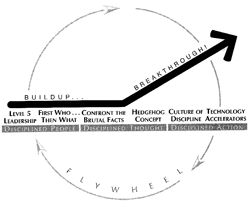
As a business gets steadily better, Collins comments, the ability of the company to reach greatness increases, because their momentum increases.
This is similar to our class, where if we work hard and we are getting closer to finishing, the harder we work, and therefore the more likely we are to succeed. For example, on the water bottle project (which I will explain in more detail on the Work Summary post), we pushed hard, and got a little bit far, but when we actually started pushing the selling, we accomplished our goal.
The last chapter of the book, Collins talked about long term success. He linked it with his other book, and said that the company has to have a set of core values to succeed in the long run. Without core values, the company will achieve success/greatness but will most likely fall apart after a short amount of time. Similarly to our class, if we don't keep up our goals and our core values, our business can fall short because we lack the vision when we don't keep core values.
Thanks for reading!
C4E Associate:
Noah Mark
This week I read further into the book Good to Great by Jim Collins.
In this chapter, Collins describes two cycles that demonstrate the way that business decisions tend to accumulate incrementally in either an advantageous or a disadvantageous manner. In essence, he is saying that failure cannot happen suddenly/instantly, rather it occurs over time, and vice versa.
He shows us that the transition from a good business to a great business is accomplished by following the flywheel effect:
As a business gets steadily better, Collins comments, the ability of the company to reach greatness increases, because their momentum increases.
This is similar to our class, where if we work hard and we are getting closer to finishing, the harder we work, and therefore the more likely we are to succeed. For example, on the water bottle project (which I will explain in more detail on the Work Summary post), we pushed hard, and got a little bit far, but when we actually started pushing the selling, we accomplished our goal.
The last chapter of the book, Collins talked about long term success. He linked it with his other book, and said that the company has to have a set of core values to succeed in the long run. Without core values, the company will achieve success/greatness but will most likely fall apart after a short amount of time. Similarly to our class, if we don't keep up our goals and our core values, our business can fall short because we lack the vision when we don't keep core values.
Thanks for reading!
C4E Associate:
Noah Mark
Subscribe to:
Comments (Atom)